

The Seven Domains of CLARITY
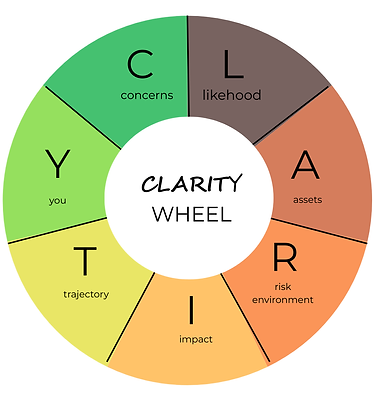
The CLARITY framework identifies seven domains that commonly appear in safeguarding assessments.
These domains form the structure of the wheel.


C — Concerns
Every safeguarding assessment begins with concerns.
Concerns may arise from observations made by professionals, reports from members of the public, information from other agencies, or disclosures from children themselves. Sometimes concerns develop gradually as patterns of behaviour become visible over time.
The first task in any assessment is to clarify these concerns.
-
What exactly are we worried about?
-
What evidence supports this concern?
-
What has been observed or reported?
Without clearly identifying the concern, it becomes difficult to analyse the situation further.

L — Likelihood
Once a potential harm scenario has been identified, practitioners must consider the likelihood that the harm could occur.
Likelihood asks a straightforward question:
How likely is this harm to occur based on the available information?
This judgement draws on history, current circumstances, and professional experience. While it cannot produce certainty, it helps professionals estimate the probability of harm.

A — Assets
Safeguarding assessments are not only about risks. Families often possess strengths and protective factors that reduce the likelihood of harm.
Assets may include supportive relatives, engagement with services, positive relationships with teachers or community members, and stable routines within the home.
Recognising these strengths is essential for balanced assessment. A situation that appears risky may be mitigated by protective factors that help safeguard the child.

R — Risk Scenario
A common difficulty in safeguarding discussions is that the potential harm remains vague.
Professionals may say that a situation is risky without clearly identifying what harm they believe might occur.
The CLARITY framework encourages practitioners to define the risk scenario more precisely.
What harm might realistically occur if the situation remains unchanged?
For example:
-
escalation of violence between adults
-
neglect affecting a child’s development
-
exposure to exploitation outside the home
Naming the harm scenario helps focus professional thinking.

I — Impact
Impact refers to the seriousness of harm if it were to occur.
Some harms may cause temporary distress, while others may have severe or life-threatening consequences. Recognising the seriousness of potential harm helps professionals understand the gravity of the situation.
In safeguarding practice, the highest level of impact may involve death or serious assault, while lower levels may involve emotional distress or developmental concerns.

T — Trajectory
Safeguarding situations are rarely static. Families experience changes in relationships, health, employment, housing, and support networks.
Trajectory asks an important question:
Is the situation improving, remaining stable, or deteriorating?
Understanding the direction of change helps practitioners anticipate future developments. A situation that appears manageable today may become more serious if the trajectory is worsening.

Y — You
At the centre of the CLARITY framework lies professional judgement.
Frameworks and tools can help organise information, but they cannot replace the insight and responsibility of the practitioner. Professional judgement brings together all elements of the assessment to form an overall view of the situation.
The purpose of CLARITY is to support that judgement by making the reasoning behind it clearer.
Why a Wheel?
The CLARITY model is represented as a wheel rather than a checklist or linear sequence.
This design reflects how safeguarding assessments actually unfold in practice.
Professionals may begin with concerns raised by a school, then learn about protective factors within the extended family. They may later revisit the likelihood of harm as new information emerges, or reconsider the trajectory of the situation after further visits.
Thinking about safeguarding as a wheel acknowledges this dynamic process.
Practitioners can move around the wheel, revisiting different elements as their understanding develops.
Seeing the Whole Picture
The value of the CLARITY Wheel lies in its ability to bring multiple aspects of safeguarding thinking together.
-
Concerns identify what has prompted the assessment.
-
Likelihood and impact help analyse potential harm.
-
Assets highlight protective factors.
-
Risk scenarios clarify the harm being considered.
-
Trajectory reveals how the situation is changing.
-
Professional judgement integrates all of these elements.
When these domains are examined together, practitioners gain a clearer picture of the safeguarding situation.
What Is a Risk Matrix?
A risk matrix is a simple visual tool that helps professionals examine the relationship between likelihood and impact.
The matrix is typically arranged as a grid.
One axis represents likelihood, ranging from low probability to almost certain occurrence.
The other axis represents impact, ranging from minor consequences to severe or extreme harm.
Where these two dimensions intersect, they indicate the overall level of risk.
The matrix does not produce automatic answers. Instead, it provides a structured way of thinking about how probability and consequence combine.
This approach is widely used in many professional fields. Risk matrices appear in engineering, healthcare, aviation, and emergency planning. They are also reflected in widely recognised standards such as .
Although safeguarding work is different from technical disciplines, the basic logic of the matrix can still help clarify professional reasoning.
Likelihood on One Axis
In safeguarding practice, likelihood describes the probability that a particular harm scenario could occur.
As discussed in the previous chapter, likelihood is usually expressed through descriptive categories rather than numerical probabilities.
These categories might include:
-
low or rare
-
unlikely
-
possible
-
likely
-
almost certain
These terms represent professional judgement informed by available evidence.
For example, a harm scenario may be considered possible if warning signs are present but there is limited history of escalation. A scenario may be considered likely if similar incidents have occurred repeatedly and circumstances appear to be deteriorating.
Impact on the Other Axis
Impact refers to the seriousness of harm if it were to occur.
Safeguarding practice recognises that different harms carry different consequences. Some may involve temporary distress, while others may involve long-term developmental harm or life-threatening injury.
Impact levels might therefore range from:
-
low or minimal harm
-
moderate harm
-
serious harm
-
severe or extreme harm
At the highest level, extreme harm may involve death or serious assault. Recognising this level clearly helps anchor discussions about seriousness.

Combining the Two
The matrix becomes useful when likelihood and impact are considered together.
For example:
A situation with low likelihood and low impact may represent a relatively low level of risk.
A situation with high likelihood and severe impact represents a much higher level of risk.
Between these extremes lie many combinations that require careful professional judgement.
A scenario with low likelihood but severe impact may still demand attention because of the seriousness of potential harm. Conversely, a scenario with high likelihood but moderate impact may require intervention to prevent ongoing distress.
The matrix therefore helps practitioners see how different elements of risk interact.
Latest Insights & Resources
Join our community and receive the latest insights and resources on safeguarding directly to your inbox.
Stay Informed and Think Clearly
Join our community and receive the latest insights and resources on safeguarding directly to your inbox.
